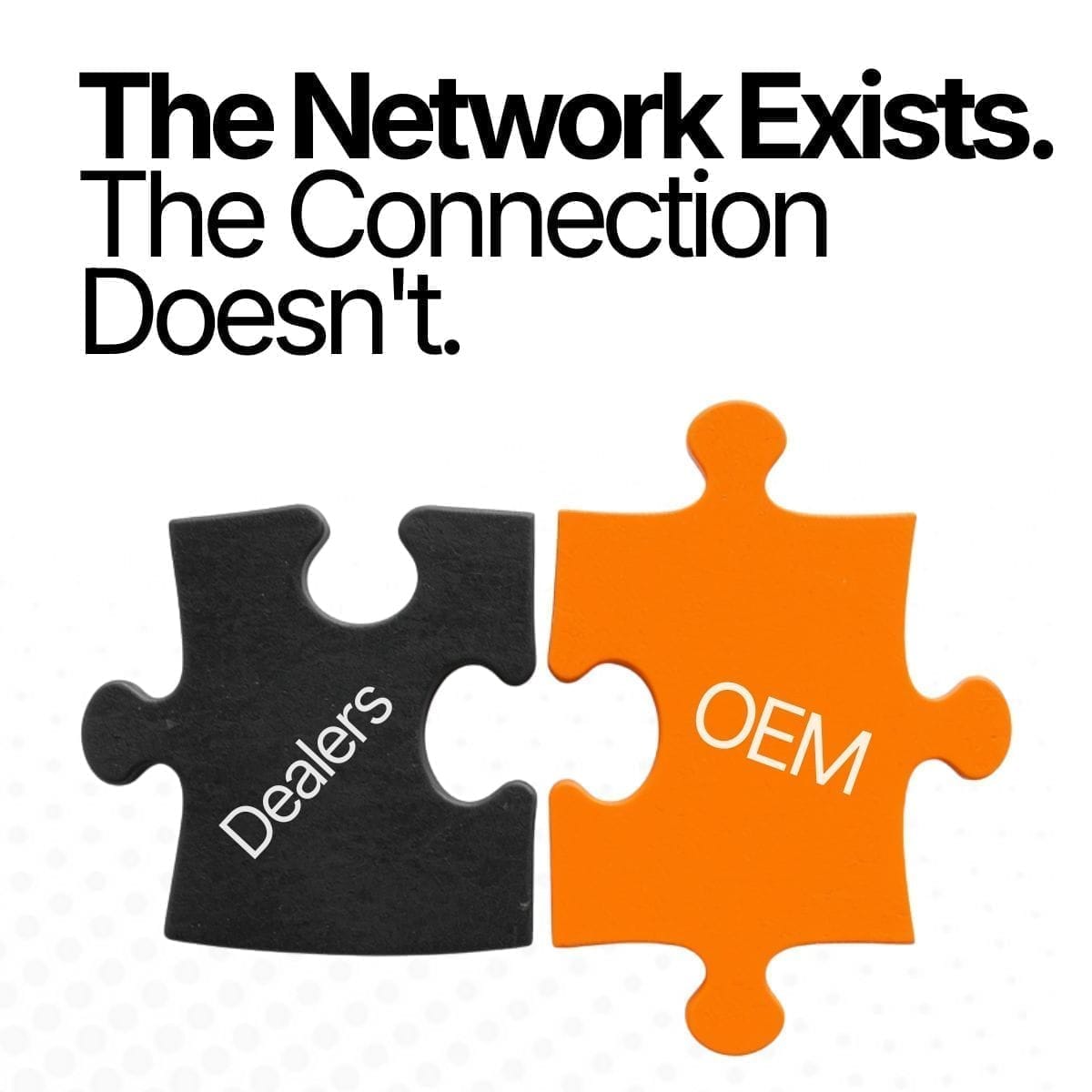
The Network Exists. The Connection Doesn't.
OEMs are investing heavily in AI. Most of them cannot reliably connect to the data that would make it work.
Across the industry, budgets are flowing into demand forecasting models, predictive maintenance platforms, and inventory optimization tools. The common assumption is that technology is the bottleneck. In most cases, it is not. The bottleneck is connectivity — specifically, the persistent structural gap between OEM backend systems and the dealer networks that generate the operational data these initiatives require.
At last month's Winning After Sales Forum in Munich, more than twenty OEMs gathered to discuss AI, digital transformation, and the commercial future of After Sales. Despite the range of topics on the agenda, one challenge surfaced in nearly every conversation: the difficulty of consistently connecting OEM systems to dealer networks at scale. That convergence was not coincidental. It reflects an architectural reality the industry has deferred for too long.
Dealer Connectivity Gap
The Gap That Was Never Supposed to Matter
Dealer data integration is the process of connecting an OEM's backend systems —typically SAP, Oracle, or a proprietary ERP — with the dealer management systems operated throughout its retail and service network. Its purpose is to enable the automated, standardized, and continuous exchange of operational data between the two sides of the business.
For most of the industry's history, this was not treated as a priority. Dealer networks were smaller. Business processes were less complex. Organizations coordinated through emails, spreadsheets, and manual data entry — methods that were imperfect but adequate for the environments in which they operated.
That environment no longer exists.
The dealer network looks connected on an organizational chart. Operationally, it functions as a collection of silos. Orders, service records, parts transactions, warranty claims, and machine data cross that gap every day — slowly, manually, and incompletely. Growing dealer networks, rising transaction volumes, increasing customer expectations, and the data demands of modern AI initiatives have collectively exposed what was always an architectural vulnerability.
The business pays for every connectivity gap, whether those costs appear as lost revenue, reduced efficiency, lower customer satisfaction, or accumulated technical debt.
The Build Decision — and Why It Seems Reasonable
When a CIO first examines this problem, the instinct to build internally is understandable. The required technologies exist. Integration expertise is already present in the organization. And the first major integrations —covering the two or three widely-used dealer management systems — appear manageable.
Those early integrations tend to succeed. That success is also misleading.
The large platforms represent only five to twenty percent of a typical dealer portfolio. They are well-documented, widely supported, and professionally maintained by experienced vendors. Building against them creates the reasonable impression that the broader integration challenge can be solved using the same approach.
It cannot...
The real complexity lies in the remaining eighty percent: the regional platforms, legacy applications, locally customized solutions, and dealer-specific implementations that vary significantly in documentation quality, technical accessibility, and data structure. This is the long tail — and it is where integration projects stall, budgets expand, and timelines dissolve.
What IT teams encounter in practice:
🔶 Incomplete or outdated technical documentation
🔶 Limited or restricted vendor access
🔶 Unique and incompatible data models
🔶 Regional customizations with no standardized structure
🔶 Internal organizational requirements that differ market to market
Each system requires analysis, mapping, testing, ongoing maintenance, monitoring, and support. Small differences accumulate across hundreds of dealers. What began as a structured project becomes a growing body of custom engineering work— difficult to staff, expensive to maintain, and brittle in the face of vendor updates and business change.
New dealer onboardings trigger additional work. Software upgrades break existing connections. Regional rollouts introduce new system variants. Costs continue to accumulate long after the original project is considered complete.
This is not an IT execution failure. It is an architectural problem — one that became structurally unsolvable the moment dealer networks scaled beyond a handful of partners.

Different ERP and DMS systems
The Cautionary Pattern
The industry has seen this dynamic before.
Across OEMs, integration initiatives rarely remain static projects. What begins as a defined effort to connect systems or standardize data flows gradually expands as dealer networks grow.
Over time, this leads to a compounding effect. Integration environments become denser, not simpler. Dependencies multiply, documentation gaps widen, and maintaining existing connections increasingly consumes the same resources that are needed to build new ones.
The specifics differ by organization and industry segment, but the underlying pattern is consistent: integration complexity is not linear. It accumulates. And once a certain scale is reached, it shifts from being a project-based challenge to a structural constraint on the entire IT and data architecture. [1, 2, 3, 4].
Three Strategic Costs of Getting This Wrong
The consequences of unresolved dealer connectivity extend well beyond the IT budget. They affect competitive positioning across three dimensions that CIOs are directly accountable for.
1. Operational performance 🟠
When dealer data arrives late, inconsistently, or not at all, the effects propagate through the business. Parts stockouts increase. Fulfillment slows. Warranty processing becomes inaccurate. Service response times lengthen, directly increasing machine downtime for end customers. Forecasting reliability degrades. Each of these outcomes has a measurable cost — in revenue, in customer satisfaction, and in dealer relationship quality.
2. AI and data capability 🔶
Every major digital initiative — AI-driven forecasting, predictive maintenance, fleet analytics, inventory optimization — depends on the same prerequisite: clean, structured, continuously available dealer data. Without reliable connectivity, these initiatives operate on incomplete inputs and produce unreliable outputs. Investment in AI capability without investment in data infrastructure is investment in potential, not performance.
3. IT resource allocation🟧
Every engineer hour spent maintaining fragmented dealer integrations is an hour not spent on the digital initiatives that create competitive advantage. Organizations trapped in integration maintenance cannot prioritize strategic capability development. The opportunity cost is difficult to quantify precisely— and easy to underestimate until it becomes structural.
An Architectural Problem Requires an Architectural Answer
Generic integration tooling was not built for this environment. ETL tools struggle where thousands of partners use different systems and deliver raw transactional data without business context. The logic required to turn a raw dealer transaction into a meaningful parts order or warranty claim has to be built, maintained, and continuously updated — work that compounds with every new dealer, every software release, and every market expansion.
The precedent for how to respond is already established.
Decades ago, many manufacturers built proprietary ERP systems because commercial alternatives were limited. As business complexity grew, most concluded that maintaining custom ERP infrastructure was not a productive use of scarce technical resources. They shifted to specialized providers — not as a concession, but as a strategic reallocation. The capability still existed. The obligation to build and maintain it did not.
Dealer connectivity is following the same trajectory. The systems, processes, and data requirements that define it are constantly evolving. New vendors enter regional markets. Existing platforms release updates. AI use cases impose new requirements on data quality, latency, and structure. Maintaining effective connectivity in this environment is not a one-time project. It requires continuous investment simply to stay current.
The question for CIOs is not whether the organization is capable of building integrations. It is whether building and maintaining integration infrastructure is the highest-value use of its technical resources.
What a Platform Approach Delivers
A dealer connectivity platform provides a standardized integration layer between OEM systems and the dealer network, independent of which management systems individual dealers operate.
Rather than managing hundreds of individual point-to-point integrations, the OEM maintains a single interface. The platform handles system changes, dealer onboarding, software upgrades, and the continuous mapping required to keep data flowing accurately. Dealer data is not simply transferred — it is interpreted, standardized, validated, and enriched with After Sales business logic before reaching OEM systems.
The structural benefit is significant: instead of owning the complexity of hundreds of individual dealer connections, the organization owns one standardized interface. Integration stops being a bottleneck and becomes an enabler.
With that foundation in place, business capabilities that were previously blocked by data gaps become operational:
🔶 Automated parts fulfillment. Dealers submit parts requests through a standardized channel connected directly to the OEM ERP. Orders are confirmed faster; fulfillment is automated.
🔶 AI-driven forecasting and inventory optimization. Reliable, structured transaction data enables inventory to be dynamically balanced across the network — reducing excess stock and stockouts simultaneously.
🔶 Predictive maintenance. IoT platforms integrated with dealer service records create a continuous loop between machine condition and service response. Anomalies trigger proactive alerts before customers contact support.
These are not theoretical benefits. They are the business outcomes that connectivity makes structurally possible — and that its absence makes structurally unavailable.

Connected Systems = Full Picture
The Decision in Front of CIOs
Dealer data integration is not a collection of IT projects. It is a foundational capability — one that determines whether every major digital initiative the organization pursues is built on a reliable operational base.
The organizations that gain durable advantage in After Sales will not be those that built the most integrations. They will be those that directed their technical resources toward the business processes and customer experiences that connectivity enables: smarter forecasting, faster service response, higher machine availability, and more agile dealer networks.
The connectivity problem is solvable. How an organization chooses to solve it — and whether that choice compounds strategic capacity or consumes it — is the decision that will separate the field.
Henry Greulich, Partner at Scaia Group
Ready to move from fragmented connections to a connected After Sales operation? Book a free consultation: Book Consultation
Sources:
[3], https://www.infosys.com/industries/automotive/case-studies/seamless-dms-integration.html