Enterprise planning systems were built for one audience: people. Dashboards, alerts, and workflows exist to help a person find information, interpret it, and decide what to do next. That design rests on an assumption now starting to crack: that a planner will always sit between the data and the decision.
As AI agents begin operating directly within these systems, that assumption no longer holds. The question worth asking is not whether AI will affect service parts planning. It is what happens to the planner's job once the system can investigate situations, evaluate options, recommend actions, and eventually execute them itself.
That shift is not a switch that flips overnight. It is a gradual change in how people, systems, and agents divide the work of planning, and it is already underway.
From Human-to-System to Agent-to-System Communication
Agents do not interact with enterprise software the way humans do. They do not read a dashboard or click through a screen. They need structured access to data, context, capabilities, and actions, so the system can tell them what is true and what they are allowed to do about it. Most enterprise planning tools were never built to answer that kind of request, which is exactly what has to change first.
Consider a common scenario: a supplier informs the OEM that a spare part shipment will be delayed. Instead of the planned 150 units, only 100 will arrive on time. The remaining 50 will not arrive for another three weeks.
Today, the planner gathers information across systems, investigates what the delay means, evaluates the available options, decides, and executes. The more complex the situation, the more branches this decision tree creates. In practice, that can mean moving between several SAP transactions and other systems to reconstruct the picture: checking current stock and requirements, reviewing material availability and stock levels in SAP MD04/MMBE, looking up purchase orders and expected receipts in SAP ME2M/ME2L, and double-checking sales orders in SAP VA03, often with notes kept in Excel to make sure everything adds up.
Each question can require another system check, another transaction, or another manual calculation before the planner can move to the next question.
- Which customer orders are now at risk?
- Where will I run into a stockout?
- How many weeks of coverage do I have at each location?
- Can I move stock from another location?
- Are there alternative or substitute parts available?
In an agentic model, the sequence looks different. An agent detects the delay, gathers the relevant context, analyzes the impact across inventory, coverage, and customer orders, and evaluates the available options on its own. It then recommends an action, or acts within defined guardrails, while the planner supervises, approves where required, and intervenes when the situation calls for judgment or carries consequences beyond the agent's mandate:
- Agent: "The delayed shipment creates a projected stockout for Part X in Region A within two weeks, putting 23 customer orders at risk."
- Agent: "Region B holds 80 units above its target coverage, while current demand does not require this stock."
- Agent: "A substitute part is available for 7 of the affected orders."
- Agent: "Recommended action: transfer 25 units from Region B to Region A and use the substitute part for the remaining 7 orders. This avoids the projected stockout while keeping Region B above its minimum coverage. Proceed?"
The point is not simply that the agent is faster. It is that the location of the work has changed. Tasks that previously required the planner to manually investigate and evaluate are now performed by the system, and the planner engages at the point of judgment rather than at every step along the way. This is often described as a shift from "human-in-the-loop," where a person participates in every step, to "human-on-the-loop," where the person stays accountable and in control without touching every step to get there.

What Makes Systems Agent-Ready
Giving an agent access to data is not the same as making a system agent-ready. A language model connected to disconnected systems is not a capable planning agent. It is a fast way to be confidently wrong.
An agent-ready system needs four things. Context tells the agent what the data means and what is happening in the process, such as why inventory sits where it does or what happened upstream. Capabilities define what the agent can actually do, like checking inventory or initiating a stock transfer. Guardrails define what it is allowed to do and under which conditions, including when an action requires the planner's approval before it executes. Feedback shows what happened after an action so the agent knows what to do next.
Standards such as the Model Context Protocol (MCP) help by giving agents a consistent way to reach data sources, tools, and workflows instead of requiring a custom integration for each one (Model Context Protocol, 2026). That connectivity is useful, but it is only the wiring. The harder work, and the real engineering effort, is building the context, capabilities, guardrails, and feedback that let an agent operate reliably.
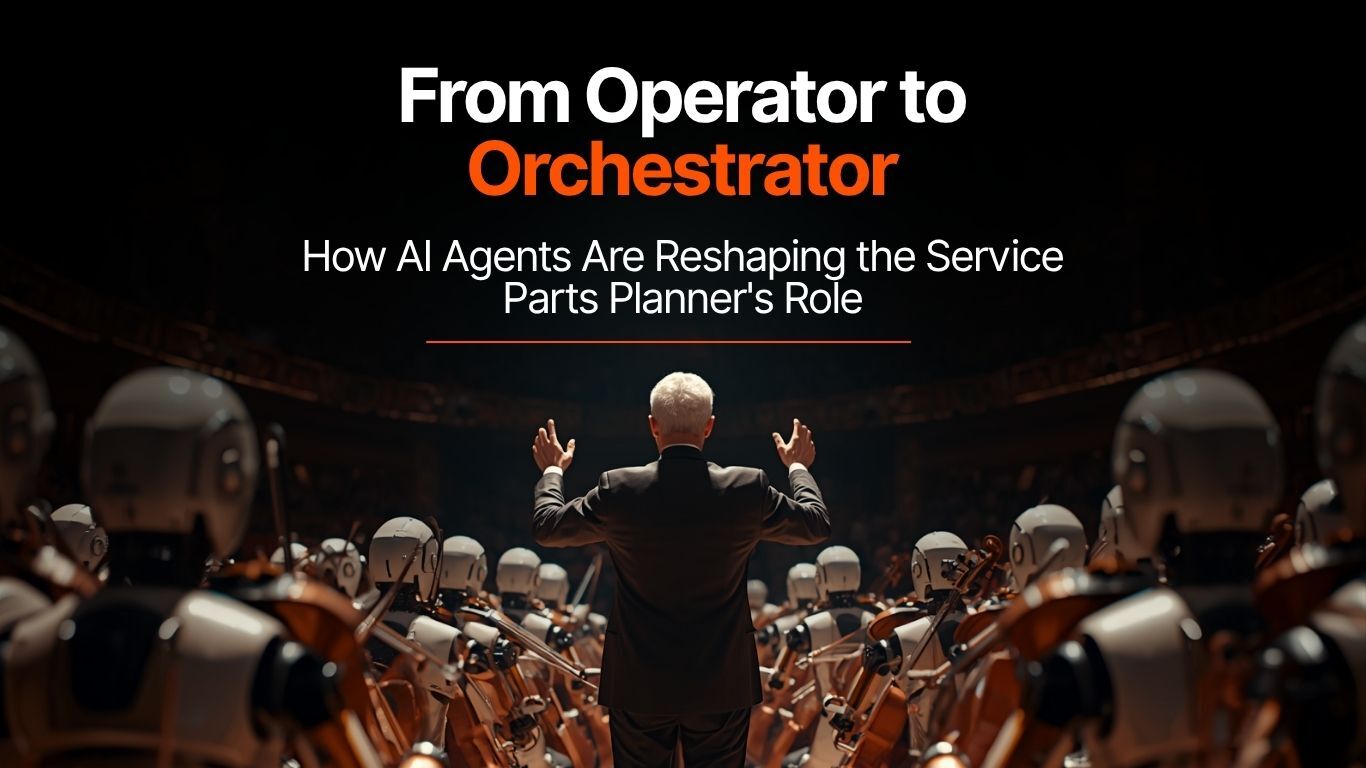
From Operator to Orchestrator
None of this removes the planner. It changes what the job is.
Today, planners spend much of their time on operational work:
- Investigating exceptions
- Gathering and validating data across systems
- Checking inventory across locations
- Calculating coverage and comparing options across locations
- Adjusting replenishment parameters
- Executing repetitive, well-understood decisions
As agents take on that throughput, the planner's work shifts toward:
- Defining objectives and setting constraints
- Reviewing agent recommendations
- Approving high-impact or high-risk actions
- Resolving conflicts between competing priorities
- Managing exceptions that fall outside agent guardrails
- Monitoring agent performance and outcomes over time
This is more than supervising a faster system. Objectives, constraints, and guardrails are what tell an agent which trade-off to make when service, inventory, and cost pull in different directions, and someone has to set them and keep them right as conditions change. The planner becomes responsible for the conditions under which planning decisions get made, not just for reviewing what the agent produced. That is what makes "orchestrator" the right word rather than "supervisor."

Why the Gap Will Widen
A planner can only investigate a limited number of exceptions in a day, no matter how skilled they are. That ceiling is not new. Early MRP-based planning systems, working from static, one-number assumptions such as a fixed supplier lead time, routinely generated hundreds of exception messages per planner per week and left the human to supply all the reasoning the system itself could not (Alicke, Supply Chain Management Review, April 2026).
The more precise argument is not that AI is faster than a planner. It is that human-driven planning is sequential by nature. One planner investigates one exception, reaches one decision, and moves to the next. Agentic planning does not have to work that way: a system built to be agent-ready can monitor many situations at once, continuously, and prioritize among them according to defined rules and constraints. That changes the unit of planning work itself, from one exception at a time to many monitored in parallel. If systems and workflows are redesigned around that shift, planning organizations may be able to operate at meaningfully greater scale than sequential, human-driven workflows allow. Whether that gap actually widens will depend on how well organizations build the context, capabilities, guardrails, and feedback described above.
The Journey Starts Now
Every AI is only as good as the decisions it makes. In After Sales, those decisions happen millions of times every day.
Manufacturers have invested billions in ERP, planning, and visibility. Yet many of the highest value After Sales decisions, such as what part is needed, where it should be positioned, when it should be replenished, and why demand is changing, remain fragmented, reactive, and largely manual.
Together, Celonis and ClearOps are building towards a fundamentally different way of running After Sales, where intelligent agents increasingly understand, reason, and act, while After Sales teams move from managing individual decisions to orchestrating an increasingly autonomous operation. The result: an autonomous, agentic After Sales platform that changes what is possible in After Sales.
Two critical building blocks enable this transition:
1. Connected Planning Foundation: Systems, data, and process context become connected, giving the agent the context it needs to understand what is happening and why.
2. Agentic Planning & Recommendation: Agents detect deviations, analyze root causes, model scenarios, and reason about what should change, turning insight into recommended actions.
Sources
- The planner was the system: Supply Chain Management Review, April 2026.
- What is the Model Context Protocol (MCP)?: Model Context Protocol, 2026.