92% of companies are not AI-ready, primarily because their foundational data is fragmented and siloed across different systems, according to Cisco's 2023 AI Readiness Index.
OEMs want to use AI to drive growth, improve service, optimize parts availability, and increasingly automate decisions and processes. But the data and context needed to enable these use cases is spread across the OEM and its dealer network, with many important insights hidden within dealer systems.
Knowing that a part was ordered is one thing. Knowing why it was ordered, which machine it is for, whether the customer is experiencing a breakdown, and what should happen next requires context that often sits across multiple systems and organizations.
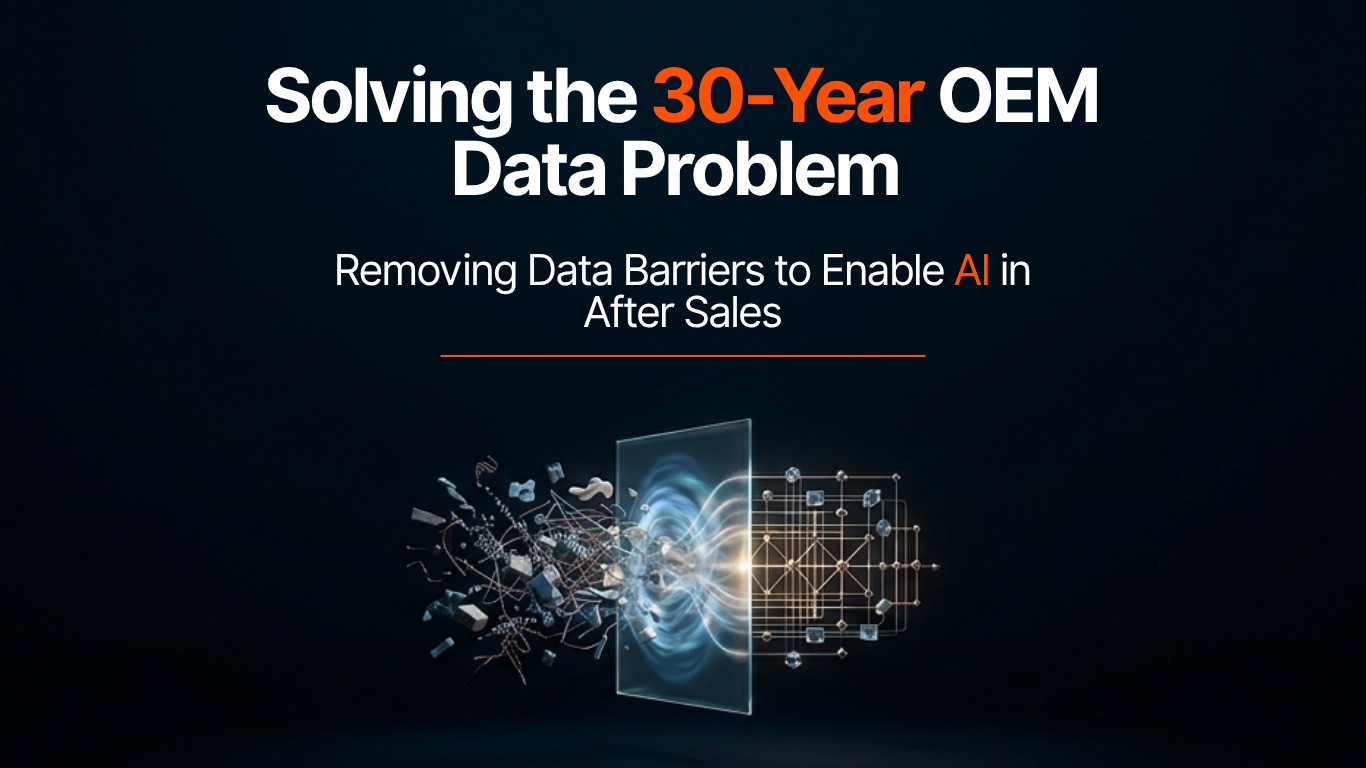
That makes the challenge bigger than choosing the right AI technology. Before OEMs can scale AI across After Sales, they need to remove the data barriers that prevent those use cases from working in the first place.
Why Now: The Battle of Attrition
Unpredictability in supply chains is the new normal, and the companies that adapt faster are the ones pulling ahead. Adaptability has become a competitive advantage in its own right.
OEMs and dealers share the same underlying interest here, even if they rarely frame it that way. Both sides need real-time visibility to act fast and serve customers well. Those who connect their ecosystem first, linking dealer systems into a single AI context layer to , are the ones positioned to outpace competitors. The data backs up the urgency:
- 85% of IT leaders say fragmented data and disconnected systems must be unified before AI can succeed (Forrester report, 2026).
- 25 to 50% of industrial OEMs lack installed base data altogether (BCG Aftermarket Services report, 2025).
- 38% of infrastructure and operations leaders say poor data quality or limited data availability was a direct cause of AI project failure (Gartner report, 2026).
Read those together and a pattern shows up. The challenge OEMs have with lack of return on AI investments, more often than not isn't the AI itself; it's the data underneath it. And for OEMs specifically, a huge chunk of the data that matters isn't even sitting inside their systems. It's tucked away inside their dealer network.
Put in budget terms: an OEM spending $20 million on AI without a context layer risks losing the full return on that spend. The same $20 million, with 10% going toward a dealer context layer first, can unlock a real return on the remaining $18 million.
The context layer is not a competing line item against the AI budget. It is what the AI budget stands on.
Removing the Data Barriers
Building an AI context layer across independent dealer networks is harder than it looks, and it breaks down into three simple barriers.
Barrier 1: Lack of Data
Without dealer network data, AI is guessing. That's not a dramatic statement; it's just what happens. If a model doesn't have the information it needs, it fills the gap with something else, whether that's a generic assumption or whatever public information it can find. Neither of those things reflects what's actually happening with your customers and your machines.
The reason this gap exists isn't because OEMs haven't tried. It's structural. Dealer Management Systems are built differently from each other. Different data models, different transfer protocols, different ways of working, and often customized further by region, software version, and even customer. No OEM, no matter how much leverage they think they have, is going to convince their independent dealer network to standardize on one API schema and data model at scale. Dealers run their own businesses, and DMS's serve the Dealers.
The consequence for AI is straightforward. Gaps in the data set the wrong baseline for quality from the start. The model will try to fill those gaps on its own, which means accuracy and trust both go down.

Barrier 2: Integrations Do not Scale
Here's the part that gets underestimated, even by teams that understand the first barrier well. OEMs are experts in building and maintaining machines – they are not technology companies responsible for maintaining hundreds of individual dealer-system integrations. Those are genuinely two different businesses, and trying to be both at once is a distraction from the one you're actually good at.
It's expensive in time, money, and internal political capital to build a custom connection to every DMS's specific requirements. Maintenance costs grow as more systems get connected and integrations get deeper, not linearly but closer to exponentially. Internal IT teams end up fighting for budget and headcount against the company's actual core competencies, every single cycle. DMS vendors keep changing their own technology, which means the integrations you built last year need rework this year. And delivery timelines on the DMS side are largely out of your control, dependent on their internal priorities, not yours.
But the part that really makes the scale problem concrete is this: it's not a one-time cost. Say an OEM integrates with dozens of DMS systems to get visibility into dealer parts inventory. That's a real, useful use case on its own. Now the OEM wants to push machine-hour data into those same systems to identify service opportunities. That's not an extension of the first integration; it's a new integration request with unique requirements across the same systems. Want to add warranty claims data as a third use case? Same story. Back to the beginning, with additional costs in time and money.
The real question was never "can we connect our dealers once." It's, "can we build a foundation that supports ever growing use cases over time." Most internal efforts answer the first question and never get to the second.
This is where ClearOps approaches it differently. We already have integrations across the major DMSs, and because we support a number of different use cases on top of that connectivity, new customers can generally leverage those existing integrations rather than starting from a blank page.
With ClearOps, OEM doesn't need to rebuild an integration architecture for every new use case. They choose which apps they want to activate on top of the network we've already built.

Barrier 3: Missing Context
This is the barrier I think matters most, because it's the one that determines whether AI is actually useful once you've solved the connectivity problem.
Take a simple example. An order comes in for five units of a part. Looking at the raw data and request, that's a routine restock. Nothing interesting to note.
Now add context. The part order is flagged as an emergency. The customer has bought four new machines in the last five years. The machine in question has already been down for 52 hours. Suddenly that same order isn't routine at all. It's a critical breakdown involving a high-value, loyal customer, and it should be expedited, or even transferred from another nearby dealer.
That's the whole point in one example. Context transforms data into intelligence. Raw data tells you what happened. Context tells you why it happened and what should happen next. Without context, AI tends to hallucinate, filling gaps with assumptions that sound plausible but aren't grounded in anything real. With context, it can actually accelerate good decisions instead of manufacturing bad ones.
This only gets more important as AI moves from generating information toward taking action. An agent that's allowed to execute a workflow on your behalf needs more than raw data points. It needs the rules, the constraints, and the situational signals required to make an appropriate call.
The progression is simple Raw Data → Structured Data → Contextual Data → AI Action
Building the Context Base
Getting to AI ROI happens in stages. The goal is to build a foundation that becomes more valuable as more data and context are added.
This is also where it is important to distinguish between a data lake and an AI-ready context layer. A data lake can centralize large amounts of raw data, but storing data is not the same as making it useful. Without structure, business logic, and context, organizations still need additional work to turn that data into something AI can act on.
An AI-ready context layer is different. It takes the connected data and structures it around the business context in which it needs to be used. Business rules and guardrails can be built into that layer, so AI is not working from raw data alone. It has the relevant context to understand what the data means and what actions are appropriate.
AI in After Sales Is Growing Quickly, But It Needs the Right Foundation
Once the data is connected, structured, and AI-ready, OEMs can start putting it to work to enable AI initiatives across After Sales.
This is where the ClearOps Dealer Operating Network comes in. With the underlying data and context available, it can enable use cases such as auto-balancing parts supply across the dealer network, proactive maintenance, individualized eCommerce promotions, and lifetime value alerts. Over time, it can also support more autonomous use cases such as agentic Connectivity and Service Parts Planning.
The Context Layer prepares the data for AI, while the Dealer Operating Network provides the foundation for applying that intelligence across the dealer network and into meaningful After Sales value.
That is the real opportunity: remove the data barriers that stand in the way of AI, build the context foundation once, and use it to enable the next generation of AI initiatives in After Sales.

Sources
- Cisco AI Readiness report, 2023.
- Forrester report, 2026.
- BCG Aftermarket Services report, 2025.
- Gartner report, 2026.