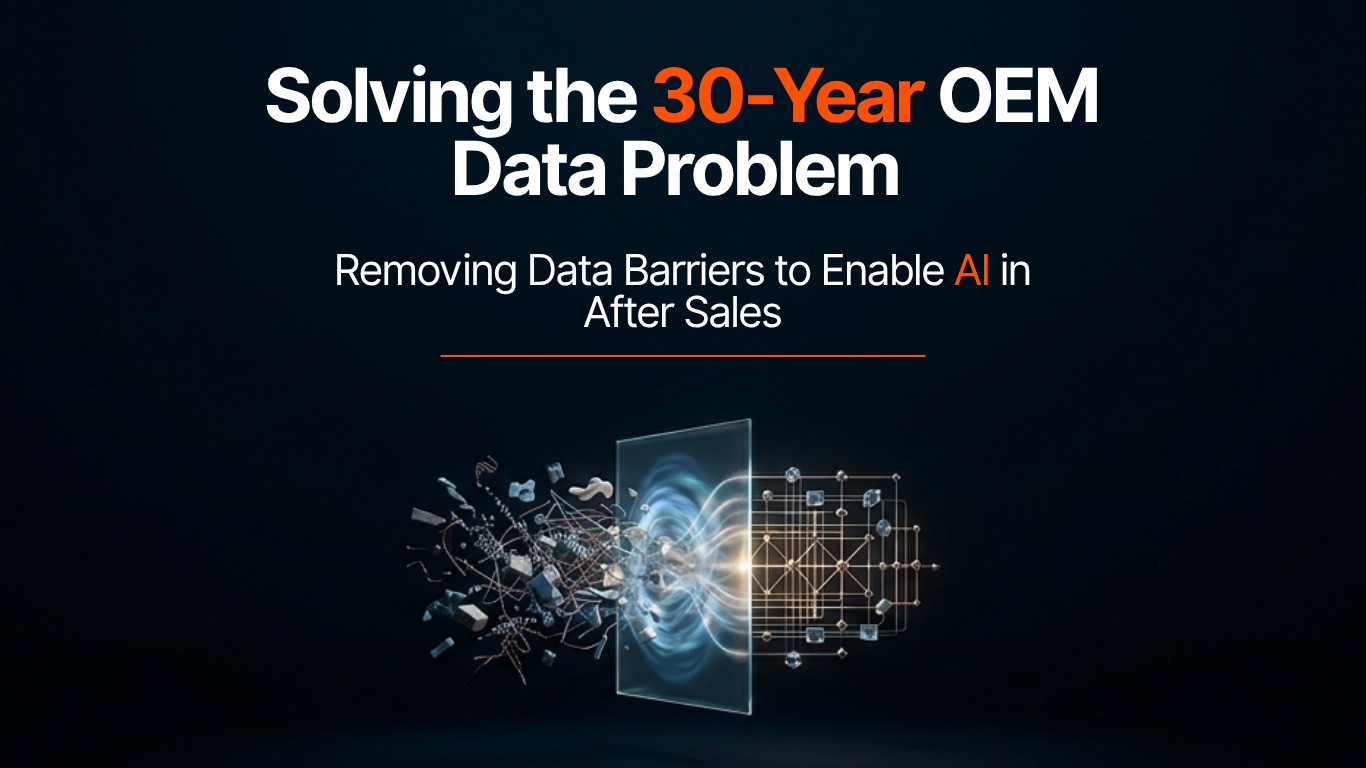

Introduction: After Sales Enters a New Phase in 2026
The conversation around After Sales has fundamentally shifted thanks to AI and changes in IT spending. What was once regarded as a necessary support function is now recognized as a strategic growth engine for OEMs and their service networks. Industry data underscores this shift: aftermarket service offerings deliver gross margins roughly double the 15% to 25% commonly generated by equipment sales, while also fostering durable customer relationships that increase loyalty, retention, and repeat purchases (BCG, 2025).
According to Gartner, 2026 marks a critical inflection point for supply chain leaders. The era of experimentation is ending; the era of execution has arrived. After Sales leaders are no longer measured by innovation initiatives launched, but by measurable impact delivered – service contracts, customer activation, parts revenues, and more.
The question is no longer whether to invest in After Sales transformation, but how to ensure those investments generate tangible returns.
The Trends Everyone Is Talking About
Across industries and conferences, the same After Sales trends dominate the conversation:
🔶 Artificial intelligence is entering every corner of After Sales operations — from service copilots and intelligent parts planning to inventory optimization, forecasting, and predictive maintenance. Machine learning increasingly analyzes patterns in equipment performance, customer behavior, and supply chain dynamics, enabling not only deeper insights but also more automated, proactive decision-making across the entire service lifecycle.
🔶 Predictive and condition-based maintenance is becoming the expected standard. Rather than fixed service intervals, OEMs move toward maintenance that responds to actual equipment conditions, identifying potential failures before they occur.
🔶 Connected machines and digital twins reshape service delivery. IoT sensors continuously transmit performance data, creating virtual replicas that enable remote diagnostics, performance optimization, and unprecedented visibility into asset health.
🔶 Platform and ecosystem strategies replace isolated tools. Fragmented software landscapes give way to integrated platforms connecting all stakeholders.
The momentum behind these trends is undeniable. Industry investment continues to accelerate, and the expectations surrounding these technologies have never been higher.
Why These Trends Are So Attractive for OEM After Sales
The appeal of these trends is not mysterious. Furthermore, their combination reveals the full potential of After Sales, promising substantial benefits that directly address the core challenges facing After Sales organizations:
🔶 Reducing unplanned downtime directly lowers operating costs while strengthening customer satisfaction. Organizations implementing predictive maintenance report 30-50% decreases in unplanned downtime (iiot-world, 2025). Where downtime costs exceed $125,000 per hour, these reductions generate millions in annual savings while dramatically improving customer satisfaction.
🔶 Parts revenue grows sustainably. Increased parts sales result from identifying demand earlier and aligning parts availability with actual machine usage and failure patterns. Advanced analytics and connected machine data enable OEMs to shift from reactive to opportunity-driven parts sales.
🔶 Planning stability increases dramatically. More predictable parts demand across regions and dealer networks enables proactive replenishment instead of reactive firefighting. McKinsey research demonstrates that AI-powered demand forecasting reduces forecast errors in supply chain networks, leading up to a 65% reduction in lost sales due to stockouts.
🔶 After Sales profitability increases. Expanded service contracts, higher parts sales, and improved lifecycle value per machine drive revenue growth. McKinsey analysis across 30 industries found that average EBIT margin for aftermarket services is 25%, compared to just 10% for new equipment. Leading OEMs now generate 40-50% of their total profits from After Sales, a figure that far exceeds margins on new equipment sales (Deloitte, 2025).
Forrester Research identifies After Sales services and supply chain operations as pivotal to enterprise resilience, revenue expansion, and competitive advantage in 2026. According to the research, more than 73% of B2B revenue comes from existing customers, while industrial companies generate 40–50% of their total profits from services delivered to their installed base (Forrester, 2025).
The business case for investing in After Sales innovation is stronger than ever. Yet despite this compelling logic, many OEMs struggle to translate these opportunities into results
The Gap Between Expectations and Reality
Nearly every After Sales leader has launched pilots, proof-of-concepts, and innovation programs. Yet tangible impact often remains frustratingly limited. Initiatives stay local and isolated.
The challenge is rarely the idea itself, but the environment in which it must operate.
Most After Sales trends depend on the same fundamental requirements. The most sophisticated predictive maintenance algorithm cannot function without clean, structured data. The most advanced AI cannot optimize parts inventory when systems aren't connected and information remains siloed.
After Sales transformation is primarily a foundation challenge.
The Three Foundations That Make Trends Work
Before any OEM can successfully implement the trends discussed above, three fundamental capabilities must be in place.
Foundation #1: Knowing Your After Sales Business
True business transparency requires a clear understanding of parts demand drivers, service volumes, failure patterns, and repair processes. Many OEMs can report parts shipped but struggle to explain why demand spiked for certain components, or they lack visibility on dealer inventory stock levels altogether, including which parts were actually sold by the dealers. Without visibility into what drives value and creates cost, optimization becomes guesswork.
This foundation requires:
🔶 Transparency on service volumes, workorders, failures, and repair patterns across installed bases
🔶 Clear metrics for measuring performance consistently across regions and dealer networks
🔶 Transparency on inventory stock levels, parts availability, and historic sales volumes
You cannot improve what you don't measure, and you cannot measure what you do not understand.
Foundation #2: Knowing Your Customer, Beyond the OEM Boundary
For most OEMs, the brand experience is delivered primarily through dealers, service partners, and field technicians. Especially in industries with moving machinery, end customers interact far more frequently with dealers than with the OEM itself. As a result, a significant knowledge gap emerges: while the OEM owns the brand, the dealer owns most customer interactions.
Customers engage through multiple touchpoints — call centers, workshops, digital portals, service technicians, and on-site visits. Yet many OEMs still lack a holistic view of these interactions. Critical information remains fragmented across dealer management systems, service partner platforms, and regional databases.
True After Sales excellence requires understanding the full customer journey — not only what happens inside OEM systems.
This means:
🔶 Visibility into customer interactions across all touchpoints, including those managed by dealers and service partners
🔶 Seamless integration between OEM platforms and the systems dealers actually use, rather than parallel or disconnected solutions
Achieving this level of transparency requires more than technology alone. It depends on strong relationships with dealers built on trust, data sharing, and collaboration, combined with sustained investment in connectivity and integration across the entire After Sales ecosystem.
Foundation #3: Data, Connectivity, and Structure
Data lakes are no longer optional. Data quality and consistency matter far more than data volume.
The connectivity challenge has three dimensions:
🔶 First, connecting dealer systems with OEM platforms is challenging because dealers use varied software with different data formats and integration options. Ensuring reliable two-way data flow across many dealer locations is a major task.
🔶 Second, OEM internal systems, like warranty, parts, service, and customer management, often run separately, creating silos that block a unified view needed for smart decisions.
🔶 Third, connecting with machines in the field is essential. IoT sensors produce valuable data that must flow consistently to analytics systems and be available to teams for action.
AI does not fix data problems, it amplifies them. Poor-quality data fed into machine learning produces poor-quality predictions at scale. Automation on top of inconsistent processes automates inconsistency.
Structured data management is a long-term capability requiring:
Clear data governance defining ownership, standards, and update processes
Integration architectures connecting systems without creating impossible maintenance burdens
Master data management ensuring parts, customers, and equipment are identified consistently
Founder Outlook 2026: Innovation Built on Solid Ground
The next phase of After Sales evolution is not about deploying more tools, but achieving better orchestration. The most successful OEMs will combine vision and discipline, creativity, data, innovation and execution.
How ClearOps Helps OEMs Become Future-Ready in After Sales
At ClearOps, we believe sustainable After Sales transformation does not start with the next trend — it starts with building the foundations that make innovation executable.
Our platform is designed to solve the core challenges that prevent OEMs from turning ambition into measurable results.
Connecting What After Sales Depends On
ClearOps connects OEM systems, dealer platforms, and machines in the field into one coherent After Sales ecosystem.
We enable secure, bidirectional data flows across the service network — ensuring quality, consistency, and transparency while respecting the reality of heterogeneous dealer systems. Instead of replacing existing infrastructure, ClearOps builds on top of it, creating connectivity and scalability without disruption.
From Foundations to Execution
Once these foundations are in place, OEMs can move from experimentation to execution.
ClearOps enables:
🔶 Predictive maintenance initiatives based on structured, reliable data
🔶 Automated parts planning and replenishment with real-time network visibility
🔶 AI-supported inventory optimization to balance availability and working capital
🔶 End-to-end service orchestration across OEMs, dealers, technicians, and customers
In short: ClearOps turns data and connectivity into operational impact.
My Perspective
After Sales transformation is not a one-off project — it is a long-term capability.
In 2026 and beyond, the OEMs that succeed will not be those chasing every new trend, but those building the foundations that allow innovation to scale with confidence.
At ClearOps, our mission is to help manufacturers become future-ready — by creating transparency, collaboration, and execution power across their entire After Sales ecosystem.
Because in the end, the future of After Sales will not be defined by ideas — but by the ability to make them work.